
Airport Wayfinding Signage: A Complete Guide to Effective Passenger Navigation

 Airport Wayfinding Signage: A Complete Guide to Effective Passenger Navigation
 Airport Wayfinding Signage: A Complete Guide to Effective Passenger Navigation
Airports are complex transportation environments where thousands of passengers need to move efficiently between entrances, check-in areas, security checkpoints, gates, baggage claim and ground transportation.
An effective airport wayfinding signage system helps passengers understand where they are, where they need to go and how to reach their destination with minimal confusion.
For airport operators, architects and contractors, signage is therefore more than a collection of directional signs. It is an essential part of the overall passenger experience and terminal navigation system.
1. Why Is Airport Wayfinding Signage Important?
Airports serve passengers from different countries, languages and cultural backgrounds. Many visitors are unfamiliar with the terminal layout and may also be navigating under time pressure.
Clear airport wayfinding signage can help:
- Guide passengers through complex terminal environments
- Reduce confusion and unnecessary walking
- Improve passenger flow
- Make gates and facilities easier to locate
- Support multilingual communication
- Create a more consistent airport experience
A well-planned system should allow passengers to make navigation decisions quickly without having to stop repeatedly and search for information.
2. Terminal Directional Signage
Directional signs form the backbone of an airport wayfinding system.
They guide passengers between important areas such as:
- Departures and arrivals
- Check-in counters
- Security checkpoints
- Boarding gates
- Immigration
- Baggage claim
- Airport lounges
- Restrooms
- Ground transportation
Directional information should be positioned at major decision points where passengers need to choose between different routes.
Typography, arrows, symbols and contrast should remain consistent throughout the terminal so that information can be recognized quickly.
3. Gate and Boarding Signs
Gate areas require highly visible identification because passengers often need to locate their boarding gate within a limited amount of time.
Gate signage may include:
- Gate identification numbers
- Boarding information signs
- Directional signs
- Zone identification
- Digital information displays
The design should prioritize visibility from appropriate viewing distances while integrating with the airport's architectural and visual identity.
4. Baggage Claim and Arrival Signage
After landing, passengers need clear guidance toward baggage claim, immigration, customs and airport exits.
Baggage and arrival signage should provide a continuous information path from the aircraft arrival area to the final destination.
Clear identification of baggage belts, arrival halls and transportation connections can significantly reduce confusion, especially for international travelers visiting an airport for the first time.
5. Directory and Information Signs
Large airports often require directory and information systems to help passengers understand the overall terminal layout.
These may include:
- Terminal directories
- Floor maps
- “You Are Here” maps
- Facility directories
- Digital information displays
- Flight information integration
Directories should complement directional signage rather than replace it.
Passengers should be able to understand both their current location and the next step in their journey.
6. Parking and Transportation Signage
Airport wayfinding extends beyond the terminal building.
Passengers, visitors and drivers also need clear guidance between:
- Parking areas
- Taxi stands
- Bus stations
- Metro or railway connections
- Car rental facilities
- Pick-up and drop-off zones
Consistent transportation signage helps create a seamless navigation experience between the terminal and surrounding transportation facilities.
7. Safety and Emergency Signage
Safety signage is another essential component of airport environments.
Depending on project requirements and applicable regulations, this may include signs for:
- Emergency exits
- Evacuation routes
- Fire safety equipment
- Restricted areas
- Warning information
- Accessibility routes
These signs should be highly visible and coordinated with the overall signage system while meeting applicable safety and accessibility requirements.
8. What Makes an Effective Airport Wayfinding System?
An effective airport signage system requires more than attractive graphics.
Several factors should be considered during planning and design.
Clear Information Hierarchy
The most important information should receive the highest visual priority.
Passengers should be able to distinguish destinations, directions and supporting information quickly.
Consistent Visual Language
Typography, arrows, pictograms, colors and layouts should follow a consistent design system throughout the airport.
Strategic Sign Placement
Signs should be positioned before and at key decision points, giving passengers enough time to understand directions and choose the correct route. This principle is also important when choosing the right wayfinding signage for commercial projects, where sign placement should follow actual circulation paths and user navigation needs.
Visibility and Legibility
Viewing distance, letter size, lighting conditions and surrounding visual distractions should all be considered.
Multilingual Communication
International airports may require multiple languages together with universally recognizable pictograms.
Durable Materials
Airport signage experiences continuous public use. Materials and finishes should therefore be selected according to indoor or outdoor conditions, maintenance requirements and expected service life.
9. From Wayfinding Design to Signage Manufacturing
Successful airport signage projects require close coordination between wayfinding planning, graphic design, engineering and manufacturing.
Before production, project teams should confirm:
- Sign types and quantities
- Dimensions
- Materials and finishes
- Graphic specifications
- Lighting requirements
- Mounting methods
- Electrical requirements
- Installation conditions
For customized projects, drawings, prototypes and material samples can help verify important details before mass production.
This reduces production errors and helps maintain consistency across a large signage system.
10. Choosing an Airport Signage Manufacturer
When selecting an airport signage manufacturer, project teams should consider more than production price.
A suitable manufacturing partner should be able to support:
- Custom signage engineering
- Material selection
- Metal and acrylic fabrication
- Illuminated signage production
- Prototype development
- Quality inspection
- Packaging for international transportation
- Installation guidance
- Large-scale project coordination
For international airport and transportation projects, manufacturing consistency and project coordination are especially important because a single wayfinding system may include many different sign types and installation environments.
Explore our custom signage solutions for different commercial environments, including airports, hotels, shopping malls, healthcare facilities and educational campuses.
Conclusion
Effective airport wayfinding signage helps passengers navigate complex terminal environments with greater confidence and efficiency.
From terminal directional signs and gate identification to baggage claim, parking and transportation signage, every component should work together as part of a consistent wayfinding system.
By combining clear information hierarchy, strategic placement, durable materials and reliable manufacturing, airports can create signage systems that improve both navigation efficiency and the overall passenger experience.

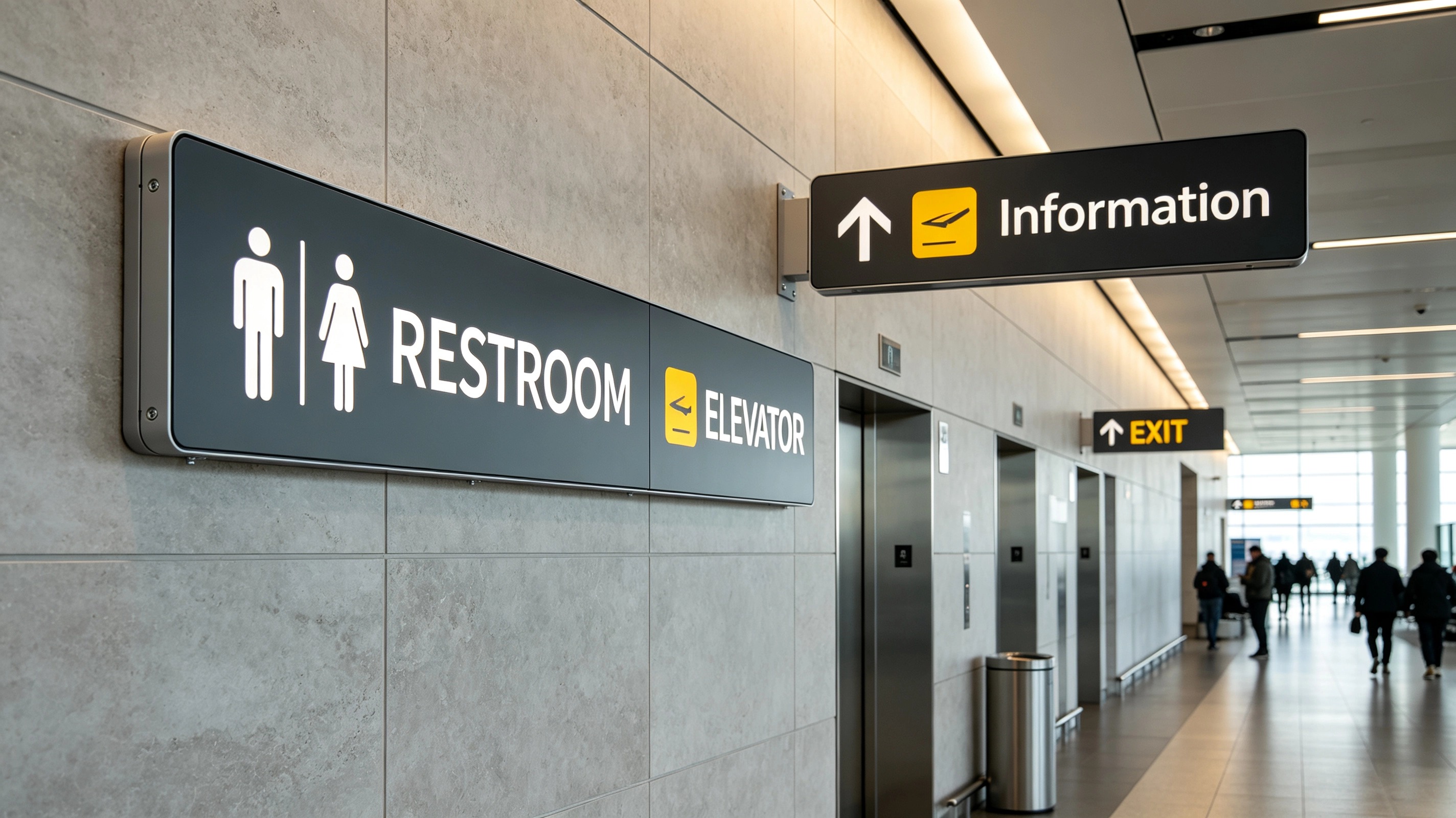
How Effective Wayfinding Signage Improves Visitor Experience